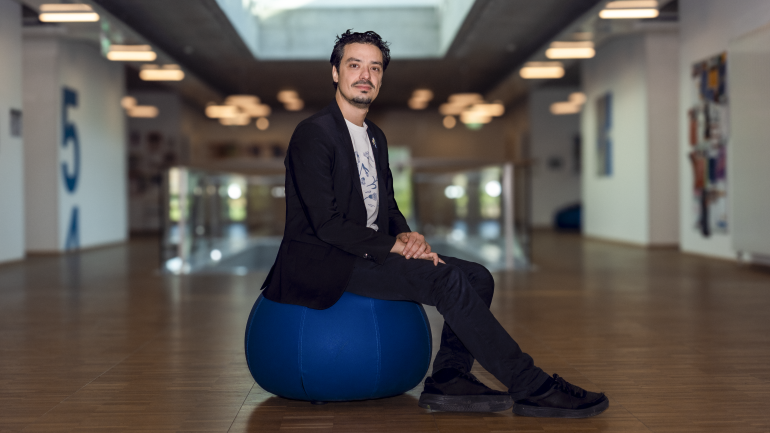
Nicolas Sommet, a social psychologist and research manager at the LIVES Centre at the University of Lausanne KA / Centre LIVES
This is a first in the history of the social sciences: a meta-analysis published in the scientific journal Nature. Behind this achievement is a social psychology researcher at the University of Lausanne, Nicolas Sommet, and his international team. Their conclusions — based on 168 studies covering over 11 million participants from around the world — challenge the widely held belief that economic inequality is detrimental to well-being and mental health. Portrait of a researcher who wears his success with a humility that borders on discomfort.
En bref
- First social science meta-analysis published in the journal Nature, based on 168 studies covering over 11 million participants across 38,335 geographical units worldwide
- The average effect of economic inequality on well-being and mental health is not only statistically null but also equivalent to zero: living in a more or less unequal society has no direct impact on happiness or psychological balance
- Inequalities act as a "catalyst" whose effect depends on the context: negative during periods of high inflation, neutral or slightly positive during periods of price stability
- Approximately 80% of existing studies on the subject present a high risk of methodological bias, revealing a structural problem in the scientific literature
- To improve collective well-being, the study recommends targeting the fight against absolute poverty rather than reducing relative inequality — a crucial distinction for guiding public policy
- Unprecedented methodological rigour: 1,536 alternative statistical models tested, replication using the Gallup World Poll (2 million respondents, 150 countries), and open-access data
Sommet, N., Fillon, A. A., Rudmann, O., Cunha, A. R. S., & Ehsan, A. (2026). No meta-analytical effect of economic inequality on well-being or mental health. Nature, 626. DOI: 10.1038/s41586-025-09797-z
Open access data and materials
"I wouldn't want people to think I'm showing off." Nicolas Sommet utters this phrase like setting up a guardrail, within the first few minutes of our interview. He is wearing what he almost always wears, like a uniform: black trousers, a T-shirt under a black blazer adorned with a chickadee-pin. He speaks quickly, with precision, articulating each word as if he had weighed it three times, and behind his large dark eyes one senses the intensity of a mind that never stops. In his office, time seems to be measured in empty coffee cups, which trace a geography of labour.
At 40, this research officer at the LIVES Centre at the University of Lausanne has just accomplished what no social science researcher had ever achieved: publishing a meta-analysis in the prestigious scientific journal Nature. This research, based on 168 studies involving over 11 million people — the largest ever conducted on the subject — shows that living in an area marked by economic inequality, where the wealth gap between rich and poor is greater, does not, contrary to what was believed, affect people's well-being and mental health.
The book that started it all
To understand the origins of this meta-analysis, we must go back to a formative reading that occurred at a pivotal moment in his career. In 2014, Nicolas Sommet discovered The Spirit Level by British epidemiologists Richard Wilkinson and Kate Pickett. Their thesis: unequal societies make their inhabitants sick and unhappy. The book travelled around the world, influencing public policies and shaping electoral platforms.
Nicolas Sommet devoured it, like so many others: "I was totally convinced," he recalls. "I thought it was a formidable utilitarian argument: we live in increasingly unequal societies, and this has a real cost to the mental health of populations." He then wrote a research proposal, secured funding, and flew to New York to join the team of Andrew J. Elliot, a leading figure in the field of motivation psychology, at the University of Rochester.
But the data told a different story. "When I was exposed to the numbers, they worked much less well than what the book claimed. I discovered very serious work on the subject that showed that in reality, these associations were much less reliable than one might have thought." He returned to Lausanne in 2016 with an obsession: understanding what inequalities really do to our psyches.
Ten thousand abstracts, 168 studies
In 2019, the Swiss National Science Foundation awarded him an Ambizione grant of approximately 612,000 francs. He launched his meta-analysis to explore the relationship between economic inequality and psychological health. Others had attempted the exercise before him. "There are three previous meta-analyses. One identified 24 studies, another 12, and a third 9. We have 168." His ambition was on a different scale.
There were "late nights of coding," as he calls them. Those sleepless nights spent verifying statistical robustness. 1,536 alternative models tested. Machine learning algorithms deployed to identify contextual factors. More than 500 World Bank indicators cross-referenced with extracted data. And to ensure the solidity of the results, a complete replication using the Gallup World Poll: up to 2 million respondents from over 150 countries between 2005 and 2021. His team grew over time: Annahita Ehsan for systematic research, Alfredo Rossi Saldanha Cunha for data extraction, Adrien Fillon for statistical analysis, and Ocyna Rudmann for tracking down unpublished results.
"Open the drawers"
For therein lies one of the major problems in scientific research: publication bias. "Only studies that work get published," explains the researcher. "Journals rarely accept a study whose conclusion is: 'we cannot conclude.' So when a team fails to observe an association, they keep the study in the drawer. This is what we call the file drawer effect."
To mitigate this problem, the team individually contacted all the researchers from the 150 studies already in their database, as well as the learned societies in the field. The message: "Open your drawers and share your unpublished studies with us." Those who cooperated helped build an unprecedented corpus. "We are extremely grateful," acknowledges Nicolas Sommet. "It's such a long process, so exhausting," he confides. "I don't know how many hours I spent on it, I think it must be beyond comprehension... Thousands of hours." He pauses. "Many times, I almost gave up." Five years passed.
The zero effect
And in the end, the result that no one expected. The main analysis — which aggregates the results of the 168 studies — reveals that the average effect of economic inequality on well-being and mental health is statistically null. In other words, living in a more or less unequal society would have no direct impact on our happiness or psychological balance.
More troubling still: approximately 80% of existing research on the subject is at high risk of methodological bias. Samples too small, control variables absent, hasty conclusions. "This is not something surprising compared to the rest of the social science literature. It's a bit disappointing. It shows that there is still much progress to be made in conducting studies that are methodologically rigorous."
Once the main result had been established, his team dug deeper, seeking to understand whether this zero effect masked variations according to context. This is what is called a moderator analysis — a secondary exploration that illuminates the overall result. And that is where a nuance emerges. Inequalities would act as a "catalyst" whose effect depends on the economic context. During periods of high inflation, when the cost of living soars, inequalities exacerbate distress. During periods of price stability, the effect reverses — it even becomes slightly positive. The study also shows that greater inequality is associated with poorer mental health in lower-income populations. "It's not that inequalities don't matter at all," he clarifies. "It's that they don't act in isolation. Context changes everything."
What this changes for Switzerland
In Switzerland, discussions about redistribution policies are influenced — consciously or not — by the idea that reducing income gaps would mechanically improve collective well-being. Nicolas Sommet's work invites a reframing. "The literature is very clear: being in a situation of economic precarity, not being able to make ends meet, being exposed to poverty... these are conditions that have disastrous effects on people's well-being and mental health." If the objective is to improve the well-being and mental health of populations, "a redistribution policy should probably be conceived less in terms of 'we absolutely must reduce inequalities in society,' and more in terms of 'how to lift as many people out of poverty as possible.' Being focused on absolute poverty rather than relative inequalities."
"I still can't believe it"
Nicolas Sommet initially refused when his co-author Adrien Fillon suggested submitting the article to Nature. "I thought we would be rejected within two days. Nature's responses are known to be expeditious. Most submissions are rejected within 48 hours." But the article went into review: "I still can't believe it. The Nature editor told me it was the first time they had published a social science meta-analysis." It took forty minutes of conversation before he mentioned what constitutes a historic first in the academic world: "It's a huge mark of recognition." He immediately added: "The important thing is to do serious work, to make a notable contribution to the literature. I am very proud of ours because we went all the way. We are also very transparent. We share all our data." Nicolas Sommet embodies a new generation of researchers for whom transparency is non-negotiable. Since 2017, all of his publications have been accompanied by raw data and analysis scripts, openly accessible: "We could do so much better collectively." He has published more than 60 papers in journals such as Nature Human Behaviour and Psychological Science. He also serves as Associate Editor at the European Journal of Social Psychology — a position that enables him to encourage, in others too, the rigour he imposes on himself.
From metal to psychology
He recounts that his choice of studying psychology was "a bit random." Upon leaving high school, he hesitated between philosophy and psychology. He opted for the latter, as the university was farther from his parents' home, enabling him to "gain his independence and take flight." From his first experimental psychology course, he was hooked. He was captivated by the idea that one could "scientifically approach the understanding of psychological processes."
Before research, there was music. From age 16 to 23, he sang in a metal band. "I was screaming and everything. It was really a cool period; at one point, music was the most important thing in my life." During his Master's, he started a rap group, performed for two years. Then the thesis came, and gradually, research replaced music. "I had to cut somewhere."
Fatherhood
Today, Nicolas Sommet is the father of a 2-year-old daughter. Fatherhood has changed his relationship with work. "When I was younger, the cards were completely mixed up, I could work constantly. Today, I have a set of rules. Work must stop at some point. Especially when I'm with my daughter."
But he acknowledges that work "never really stops when you're a researcher." During this meta-analysis in particular, "there were many moments when it was very invasive. You're always a bit in dual-task mode." Running helps me to disconnect a bit. Family moments too.
And now?
His new field of exploration? Understanding how economic inequality perpetuates itself by shaping, from school age, a culture of competition. "I think there's something to dig into there," he confides. To carry out this project, he has just obtained a two million euro consolidation grant from the European Research Council (ERC). Titled "The vicious cycle of inequalities: how economic inequality perpetuates itself by creating a culture of competition at school," the project will analyse how income gaps within society foster a competitive climate in the school system. This tends to advantage students from privileged backgrounds while penalizing those from more modest families, thus contributing to the reproduction of economic inequalities from one generation to the next. After the Swiss National Science Foundation's Ambizione grant, this ERC grant constitutes the second major institutional recognition to support — and fund — his obsession with inequalities.
For now, he awaits to see how the scientific community will receive the conclusions of his meta-analysis. "We'll see in a few months." He thinks some colleagues, experts in this literature who sensed this result, will be relieved: "It will clearly establish that we need to adjust our interpretive framework." Others, those who built their careers on demonstrating effects that he shows as "ultimately not so reliable," may have "a harder pill to swallow."
He pauses, takes another sip of coffee: "One of the beauties of science is that it is cumulative and falsifiable. There is always someone who can come along and say: I have evidence, new empirical evidence, and we will have to revise what we thought was true until now."
Nicolas Sommet has just been that someone.
By Kalina Anguelova